
The Beat Generation
Before the hippies there were intellectuals crafting their words towards freedom and social change — and wrestling with these impacts in their own lives.

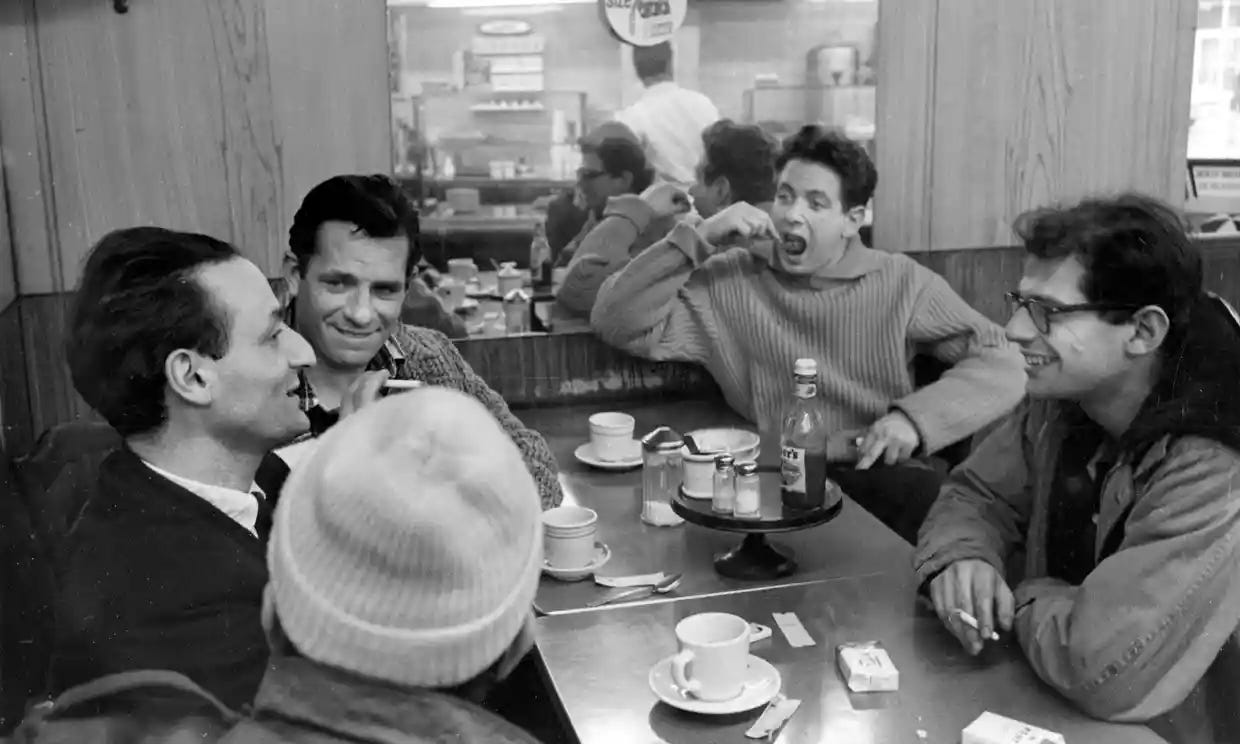
They were the first to stand up and protest what they thought was the blandness of American culture and society. If the rest of the nation was embracing, be it consciously or unconsciously, the migration to the suburbs and a nine to five lifestyle, the young men that would form what would come to be known as the Beat Generation were rejecting it. They saw suburbia as if it was a prison. It took away all the creativity in life. They were looking for some kind of freedom. If it was the hippies who carried most of these ideals out to full fruition, it was the Beat Generation who laid the path.
The first members of the movement met at Columbia University in New York City. If you attended Columbia during the 1940-50s, you were probably either one of two things: highly intelligent or well connected. You had a certain look, carried yourself with a certain flare and were surrounded by people just like you. That's why, when people watched Allen Ginsberg, Lucien Carr and Jack Kerouac walk the campus of Columbia each day, they wondered to themselves what they were doing there. They did not in any way look or act like normal Ivy League students. Everything about them was essentially wrong — their dress, their manners, even their backgrounds.
Conversations with Carr were filled with references to famous figures like Dostoevsky and Rimbaud. In his journal, Ginsberg wrote: "Know these words and you speak the Carr language: fruit, phallus, prurience, clitoris, cacoethes (a bad habit or itch, as in 'itch for writing'), feces, foetus, womb, Rimbaud." As it turns out, Ginsberg's discovery and understanding of an entire underground culture began with Lucien Carr. It was through Carr that Ginsberg met Jack Kerouac and he and Ginsberg became friends, to the surprise of both men. Kerouac's first impressions of Ginsberg hadn't been all that good. He described him as "this spindly Jewish kid with horn-rimmed glasses and tremendous ears sticking out, seventeen years old, burning black eyes..." A Columbia football star-turned-dropout, Kerouac was the child of French-Canadian parents. Moving to the United States had not been easy for either of Kerouac's parents. There was a language barrier for both — they spoke mostly French while in Quebec - and they faced the prejudice of a small New England town almost constantly. Jack would be shaped by the intensity of his childhood and often felt divided in his later years. On the one hand, he was the perfect example of the nonconformist hipster with literary goals, living on the road and doing as he pleased. But on the other hand, he was deeply burdened by his family's history in America and seemed unable to truly shed those issues.
Although Jack Kerouac was technically a jock and considered stunningly handsome by many — one woman even claimed he was the best looking man she had ever laid her eyes on — dropping out of Columbia had led him to want to become a full time writer. More than anything, the Beat Generation was a movement of writers. Those who followed the so-called “big three”— Ginsberg, Kerouac and William S. Burroughs — bonded because of their writing, consistently different and often highly controversial. Burroughs, the elder statesmen of the group, was both more stylish and confident than the others and added credibility to the group. He wore three piece suits, not exactly the dress code of the other Beat writers and his book collection at home was the stuff of legends.
Naturally, all three writers struggled to get themselves published at first. Burroughs found success with his semi-autobiographical 1953 novel Junkie, which focused on his life as a heroin user and dealer. But that was pretty much it. Neither Kerouac or Ginsberg could find their works a home. But in 1955, the tide began to change with the reading and publishing of Ginsberg's poem Howl. Today, it is one of the most recognizable poems in modern American history. But it baffled many in the mainstream publishing circle at the time. On the recommendation of a friend, Ginsberg had decided that he needed to let go, to stop trying to be someone else and truly embrace his own voice. The result was Howl, a poem that was entrenched in Ginsberg's own thoughts and feelings about the life he led and the society and culture around him. It had an almost rhythmic feeling to it, as if the phrases were punched on to the paper to the sound of bebop jazz. The reading occurred at a club in San Francisco called Six Gallery, with Kerouac in the audience drinking from a bottle of wine and encouraging his friend.
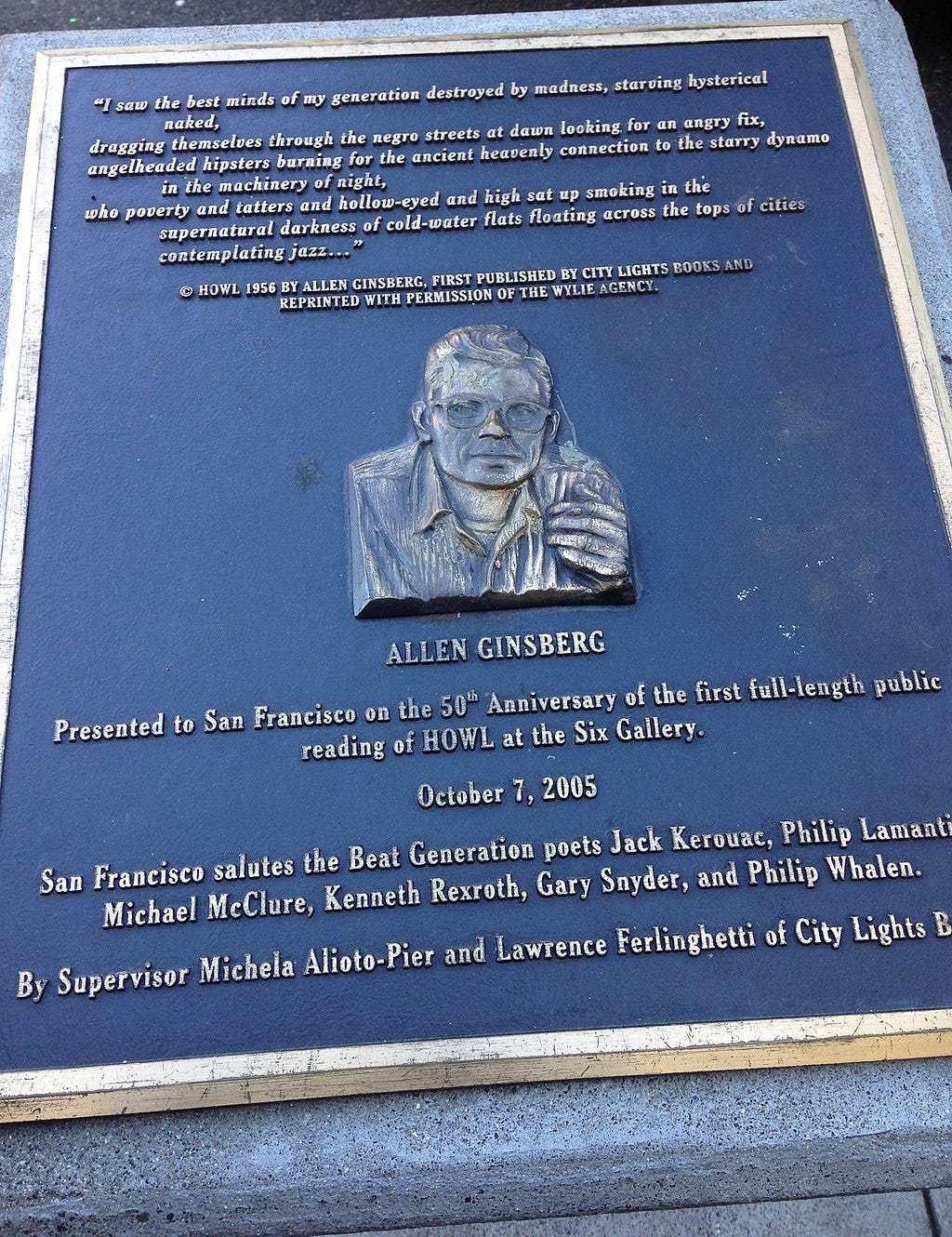
Shortly after it was published, an arrest warrant was put out for Ginsberg, who authorities claimed had written something obscene. A trial was held and, in the end, Ginsberg won. The judge deemed it not to be obscene, stating: "The first part of 'Howl' presents a picture of a nightmare world; the second part is an indictment of those elements of modern society destructive of the best qualities of human nature; such elements are predominantly identified as materialism, conformity, and the mechanization leading to war... It ends with a plea for holy living..." It was the first real big success for the Beat Generation. A door had been opened to them and their culture. Their work was no longer simply a provocation — a means to get the public's attention so they could tell them something about their stance on the politics of the day. The mainstream stopped writing off their art. They began to see it as valid. Always one to be generous with things in his life, Ginsberg pursued several publishers about Kerouac's work and Viking Publishing decided to take him on.
If Hemingway was the novelist of the Lost Generation, then Kerouac was the novelist of the Beat Generation. His classic Beat novel, On The Road, was published two years after Ginsberg's legendary first reading of Howl and it made him instantly famous. Unlike many writers, Kerouac wrote it in a fury of mad creativity. Refusing to lose his train of thought, he taped teletype paper together and fed it into his typewriter, creating one long scroll. It was just as much non-fiction as it was fiction. He changed almost nothing, leaving in the places, dates and even names of his friends. It was a celebration of an alternative lifestyle. He was twenty- eight when he wrote it and already twice married. He lived with his mom, a woman whom his hedonistic friends loathed and she loathed in return. When he had finished with the movie in his head and created the first draft of On The Road, he handed it to fellow Beat writer John Clellon Holmes without even reading it himself. Holmes thought On The Road was brilliant but that it would have very little chance making it in the traditional bookstores of the day. To do so, a great deal of coercing would need to take place.
That was the strange thing about the Beat writers. Although they wanted to pull away from the culture of America that had defined their parent's generation and embrace, more or less, the freedom of the open road, they also really wanted to be heard and respected. And so, in some ways, the very society they wanted to avoid they also wanted to be idolized by. The newfound fame that Kerouac obtained after On The Road was published in 1957 hit him harder than it did any of the other Beat writers when they finally were accepted by the mainstream. Inherently shy and removed, Kerouac suddenly found himself the prophet to thousands of young people longing for something very different than the culture that was being sold to them.
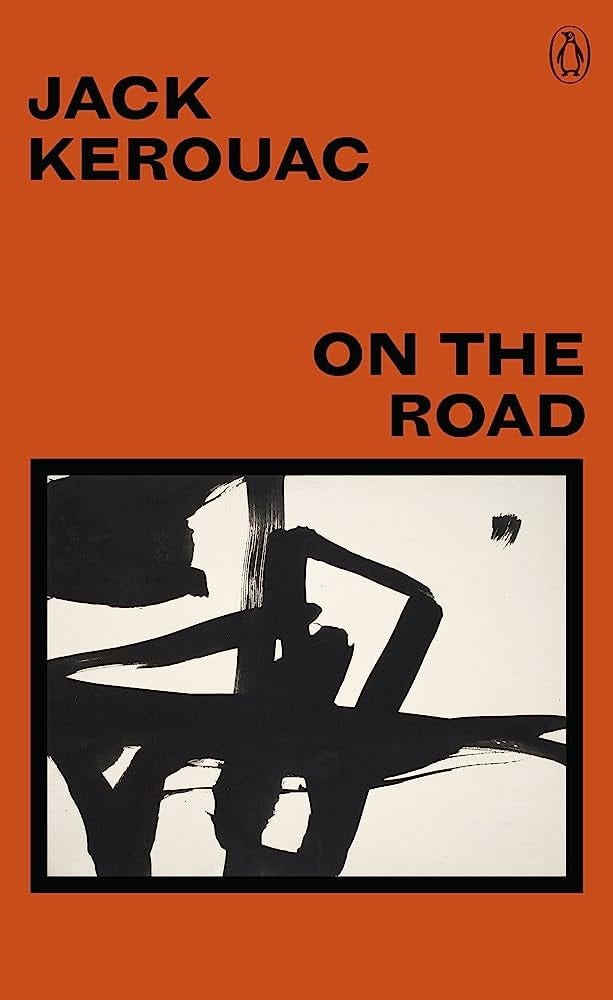
On The Road had become the pamphlet of instructions for the younger generation on how to crisscross not just the American geographical landscape but their own spirituality as well. They wanted to know more, to feel more and to have him lead them there. It was the kind of pressure that he was not really ready for. Just a few years prior, he had been nothing more than a struggling writer who couldn't seem to get published because he was too different. Now, he was the hero to thousands of young kids. In the way that Ginsberg deflected the pressures of being a famous poet, Kerouac instead carried them on his shoulders. He became like Atlas, holding up the world. And he hated it.
As the years started to pass and the culture moved closer and closer to the more outward idealism of the hippies and the counterculture movement, Ginsberg started to embrace it more and more and Kerouac started to hide. Slowly but surely, the two men's surprising friendship came to an end. Ginsberg fell into his homosexuality, his newfound friendship with Bob Dylan and his role as a sort of teacher for the new generation. Kerouac fell into drinking. The two men often argued. In a letter written to Ginsberg a few years before his death, which Gore Vidal later relayed to the world, Kerouac did not mince words, sharing that he disliked the hippies because their constant protesting of the Vietnam War "gave you an excuse to be spiteful again." By 1969, with the hippies soaking up their last true dance at Woodstock, Kerouac was dead of liver failure from his alcoholism. His death was a stark and sad reminder of the perils of gaining fame too quickly.